

ZONESUN
ZONESUN ZS-FAL180V18 Automatic Kaya Jam Filling and Glass Jar Packaging Line
ZONESUN ZS-FAL180V18 Automatic Kaya Jam Filling and Glass Jar Packaging Line
Não foi possível carregar a disponibilidade de recolha
ZONESUN ZS-FAL180V18 Automatic Kaya Jam Filling and Glass Jar Packaging Line
Description
The ZONESUN ZS-FAL180V18 is a complete automatic filling and packaging line designed for kaya jam and other viscous food products in glass jars. The line integrates bottle rinsing, high-temperature drying, servo piston filling, twist-off capping, and automatic labeling into one continuous process. With a 6-head filling system, SUS316 contact parts, steam vacuum capping, and precise labeling, it provides an efficient and hygienic solution for medium to large-scale jam production and glass jar packaging.
Key Features
- Automatic Water & Air Bottle Rinsing: Cleaning nozzles insert directly inside the containers and combine water and air rinsing to improve internal bottle cleaning before filling.
- High-Temperature Drying Tunnel: Uses far-infrared heating and high-temperature air circulation to remove residual moisture from rinsed containers before product filling.
- 6-Head Servo Piston Filling: Six filling heads work with a servo piston pump for controlled filling of viscous products such as kaya jam, with a specified filling accuracy of ±1%.
- 100–1000 ml Filling Range: The standard filling system supports 100–1000 ml, with larger filling ranges available through customization.
- SUS316 Product Contact Parts: Product-contact components of the filling machine are made from SUS316 stainless steel for hygienic food processing.
- Steam Vacuum Twist-Off Capping: Designed for compatible twist-off jar caps, combining steam and vacuum processing with controlled cap tightening and sealing.
- Differential Belt Cap Sealing: The differential belt system pre-tightens and securely seals each cap to help maintain consistent cap positioning and closure.
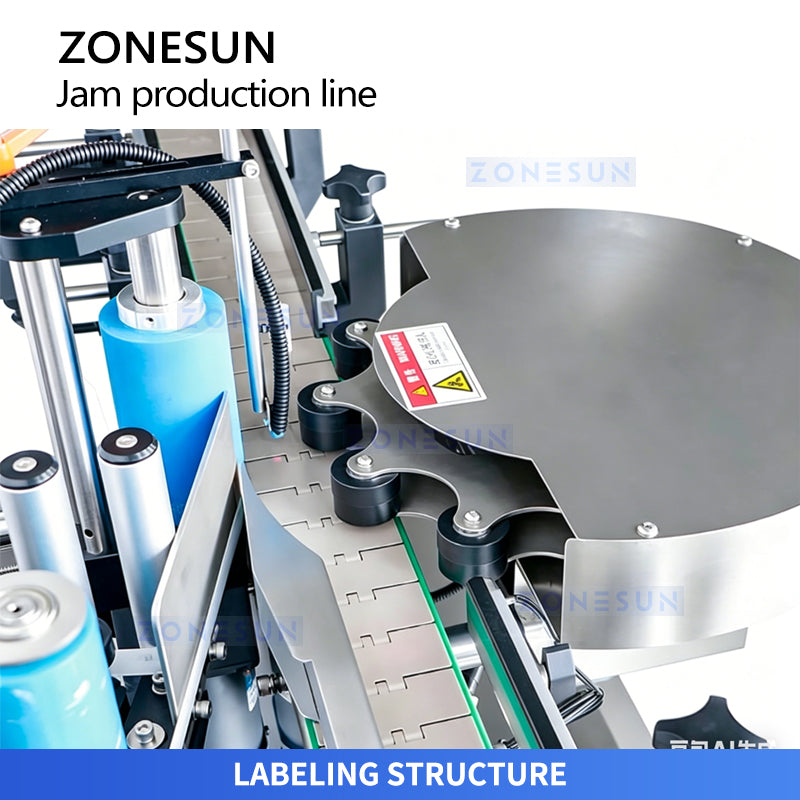
- Star-Wheel Label Positioning: The labeling machine uses a star wheel to precisely space and position jars for stable conveying and consistent label application.
- Complete Line Integration: Rinsing, drying, filling, capping, and labeling equipment are connected to form one continuous automatic glass jar packaging line.
Benefits
- Complete Packaging Automation — Integrates Rinsing → Drying → Filling → Capping → Labeling into one continuous production solution.
- 2000–5000 BPH Filling Capacity — The 6-head filling section provides approximately 2000–5000 bottles/hour, depending on filling volume and product characteristics.
- ±1% Filling Accuracy — Servo piston pump control helps maintain consistent product quantities during viscous food filling.
- Suitable for Viscous Foods — Piston filling technology is designed for compatible jam, spreads, sauces, pastes, and similar products.
- Hygienic Product Handling — Bottle cleaning before filling and SUS316 product-contact parts support hygienic food processing.
- Reliable Twist-Off Closure — Steam vacuum processing combined with differential belt sealing helps provide secure and consistent jar closure.
- Accurate Label Positioning — Star-wheel positioning improves jar spacing and stability before label application.
- Customizable Packaging Solution — Bottle size, cap size, filling range, and other equipment configurations can be adapted according to actual production requirements.
Application
Ideal for automatic filling and packaging of kaya jam, fruit jam, spreads, sauces, pastes, and other compatible viscous food products in glass jars. The complete line covers container cleaning, drying, filling, twist-off capping, and labeling, making it suitable for medium- to large-scale food processing and glass jar packaging production.


Water & Air Rinsing Nozzle
Nozzles insert directly inside bottles, combining water and air cleaning to maximize internal cleaning efficiency and hygiene.

Holds bottles securely and inverts them for complete internal rinsing, with easy adjustment to fit different bottle sizes.
Utilizes high-temperature hot air circulation within a fully automated aseptic tunnel to execute rigorous thermal sterilization on containers.

Quantity of tracking filling nozzle is customizable, filling is controlled by precise servo piston pump.

CAP SEALING
The differential belt system pre-tightens and securely seals each cap, ensuring consistent positioning and reliable sealing performance.

LABELING STRUCTURE
Equipped with a star wheel for precise bottle spacing and positioning, ensuring stable conveying and accurate, consistent labeling.

Why Choose the ZONESUN ZS-FAL180V18?
✅ Complete Turnkey Line — From Empty Jar to Finished Product: The ZS-FAL180V11 integrates Bottle Rinsing → Drying → 6-Head Filling → Steam Vacuum Capping → Labeling into one continuous packaging process, reducing the need to coordinate separate standalone machines.
✅ Water & Air Rinsing — Cleaner Containers Before Filling: Rinsing nozzles insert directly inside the bottles and combine water and air cleaning to improve internal cleaning efficiency before jars enter the drying and filling stages.
✅ High-Temperature Drying — Removes Residual Moisture: After rinsing, jars pass through the automatic drying tunnel, where far-infrared heating and hot-air circulation remove residual moisture before product filling.
✅ 6-Head Servo Piston Filling — Designed for Viscous Jam: Six filling heads use servo piston pump control for consistent filling of viscous products such as kaya jam, fruit jam, sauces, and pastes.
✅ 2000–5000 BPH — Efficient Jam Filling Production: The filling section reaches approximately 2000–5000 bottles/hour, depending on filling volume and product characteristics, supporting medium- to large-scale food production.
✅ 100–1000 ml + ±1% — Flexible & Precise Filling: The servo piston filling system supports a standard 100–1000 ml range with ±1% accuracy, while larger filling ranges can be customized.
✅ SUS316 Contact Parts — Hygienic Food Processing: Product-contact components of the filling machine are made from SUS316 stainless steel, supporting hygienic handling of compatible food products.
✅ Steam Vacuum Capping — Reliable Twist-Off Jar Sealing: The capping machine is designed for compatible twist-off caps and combines steam + vacuum processing with controlled cap sealing for reliable jar closure.
✅ Differential Belt Sealing — Stable Cap Tightening: The differential belt system pre-tightens and securely seals each cap, helping maintain consistent positioning and reliable sealing performance.
✅ Star-Wheel Labeling — Precise Jar Positioning: Instead of conventional bottle-dividing structures, the labeling section uses a star wheel for accurate jar spacing and positioning, improving conveying stability and label placement consistency.
Ideal Applications
Kaya Jam: The primary application of this line. Suitable for automatic packaging of kaya jam into compatible glass jars with rinsing, drying, filling, twist-off capping, and labeling.
Fruit Jam: Ideal for compatible fruit jam products requiring servo piston filling and glass jar packaging.
Spreads: Suitable for compatible viscous food spreads that can be reliably handled by the servo piston filling system.
Sauces: Can be configured for compatible viscous sauces packaged in glass jars.
Pastes: Suitable for compatible food pastes requiring controlled piston filling.
250 g Glass Jar Products: The source project specifically references a complete 250 g kaya jam filling and glass jar packaging solution, making this one of the representative applications for the line.
Twist-Off Glass Jars: Particularly suitable for compatible glass jars using twist-off caps that can be processed by the steam vacuum capping system.
100–1000 ml Food Products: The standard filling machine supports 100–1000 ml, while larger filling volumes can be customized according to production requirements.
Medium & Large-Scale Jam Production: With a filling capacity of approximately 2000–5000 BPH, the line is designed for manufacturers moving from individual machines toward continuous automated food packaging.
Customized Glass Jar Packaging Lines: Bottle dimensions, filling range, twist-off cap specifications, and equipment configuration can be adapted according to the actual jar, cap, product viscosity, and required production capacity.